Showing posts with label Savanna. Show all posts

Tuesday, November 30, 2010

Tombstone Tuesday: Freda E. (Hoffman) Grill


Freda's gravestone is the last of those of John Hoffman's children in the Savanna City Cemetery. She was born in Savanna, Illinois, 15 August 1888 and married Otto Grill there on 28 June 1916, Paul Froehlke, a Lutheran minister, officiating. Otto was born in Chicago to Bohemian immigrant parents. They lived their lives in Savanna where Otto worked for the railroad. They lived next door to Freda's sister Tillie and her Bowers family. The Grills had no children.

The cemetery photo is from 19 June 2002. Freda's picture is cropped from a portrait of all five of John Hoffman's daughters copied from an original provided by Ruth Whalen.

Tuesday, November 23, 2010

Tombstone Tuesday: Mathilda K. (Hoffman) Bowers

Another of the children of John Hoffman buried in the Savanna City Cemetery is his daughter Mathilda K. (Hoffman) Bowers who was known as Tillie. She was married 28 June 1906 to Clarence Elmer Bowers who died 10 April 1951. Tillie passed away 8 September 1973 in Florida but was buried with her husband in Illinois. John and Kunigunda (Schneider) Hoffman had twelve children. Five of them died very young and are buried in the Elizabeth City Cemetery in neighboring Jo Daviess County, one without name or stone. Four of the remaining children are buried in the Savanna City Cemetery as are their parents: Emma, Mathilda (Tillie), Freda, and Rudolph. Margaret (Maggie) is buried in Colorado, Bertha in Wisconsin and Harry in another Carroll County, Illinois, cemetery. (Photographed in June 2002.)

Sunday, November 21, 2010

Sunday’s Obituary: Clarence J. Rose, 1977


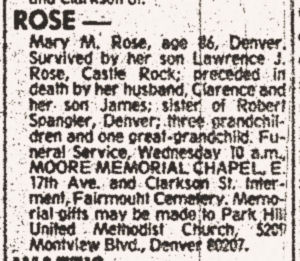
Clarence John Rose was the first grandson of immigrant John Hoffman. Clarence was born 14 October 1892 in Savanna, Illinois, to Emil and Margaret "Maggie" (Hoffman) Rose. Like his uncle, Rudolph G. Hoffman, and second cousin, Aaron H. Kelly, he served in World War I. He later lived in Denver, Colorado. About 1929 Clarence married Mary M. Spangler. As noted, they had two sons, James Allen Rose and Lawrence J. Rose.
    Funeral Notice of Clarence J. Rose, Rocky Mountain News, Denver, Colorado, Aug. 8, 1977.
    Funeral Notice of Mary M. Rose, Rocky Mountain News, Denver, Colorado, Jan. 25, 1988.
 
This photograph must have been sent to Clarence's Aunt Bertha. He is with his mother who was by that time married to James Frank Rush and living near Lamar, Colorado.

Tuesday, November 16, 2010

Tombstone Tuesday: Rudolph G. Hoffman

Rudolph G. Hoffman, youngest child of immigrant John Hoffman is buried in the Savanna Cemetery, Savanna, Illinois. Buried with him is his wife Celia Azalea (Vandervate) Hoffman. Rudolph's dates are 13 August 1892 to 27 January 1958. Celia's are 23 October 1897 to 18 September 1970. They were married 21 June 1923 in Savanna by Rev. G. W. Fischer. They had no children. (Photographed in June 2002.)

Monday, November 15, 2010

Military Monday: Sgt. Rudolph G. Hoffman


Rudolph G. Hoffman (or George Rudolph) was the youngest child of immigrant John Hoffman. Rudolph grew up in Savanna, Illinois, and worked for the railroad. In 1918 he joined the army, going to Europe in the AEF. As a fluent speaker of German, from his German mother and Swiss father, he was useful to the army both during and after the war. In January of 1919 he wrote letters to his sister Bertha in La Crosse, Wisconsin, from Coblenz, Germany where he was happy to have a feather bed to sleep in. His address was then Sgt. R. G. Hoffman, Headquarters 3rd Army, G 2 B Coblenz Germany. I believe a set of photos shared by two of his nieces, Ruth Whalen and Lucille McCue, are from the family's celebration of his return home. They were thankful for his return and that the entire family survived the influenza epidemic.

Thursday, October 28, 2010

Treasure Chest Thursday: Alma Rose posed with pooch

This photo of young Alma Rose and the pooch is quite charming. I wonder if it was her dog or the photographer's? The photo is a postcard mailed to her Aunt Bertha. Bertha was very fond of her older sister Maggie, Alma's mother and kept in touch, even visiting after Maggie moved to Colorado. It passed down to Bertha's daughter Ruth who shared it with me so that I could share a scan of it. I think all these old family photos are real treasures.


Alma E. Rose was born on 29 October 1894 to Emil and Margaret K. (Hoffman) Rose in Illinois. She was the second grandchild of immigrant John Hoffman of Savanna, Illinois. Her brother Clarence turned two fifteen days earlier. In 1900 Alma and her mother lived in Pearl City in Stephenson County, Illinois. Margaret, also known as Maggie, was working as a milliner and claimed to be a widow. Clarence was living with his grandfather Hoffman. Frank Rush became step-father to Alma and Clarence and in 1910 they all lived on Main Street in Pearl City where Frank had a barber shop. His full name was James Frank Rush. Not long after, the family moved to eastern Colorado and took up farming.

About 1916 Alma married widower Hugh L. Jenkins who had a son, Roy M. Jenkins. Hugh was a farm worker near Lamar in Prowers County, Colorado. Alma gave birth to a daughter, Margaret Rose, in 1917 and a son, Hugh L. Jenkins, Jr., at the end of 1918. Alma’s mother died in 1924, buried in Home Cemetery near McClave in Bent County, Colorado. Her step-father lived with the Jenkins family in 1930. Prowers County is part of the area affected by the Dust Bowl in the 1930s, but Alma and Hugh must have continued to live there as both were buried in Lamar’s Riverside Cemetery with Hugh’s first wife Lillian M. Jenkins. Alma died on 20 February 1949 at the young age of fifty-four.

-------------------------------------
1900 U.S. census, Stephenson County, Illinois, population schedule, Pearl City, Loran Township, ED 100, sheet 6A, dwelling 95, family 99, Margaret Rose household; National Archives microfilm T623, roll 346.

1910 U.S. census, Stephenson County, Illinois, population schedule, Pearl City Village, Loran Township, ED 110, sheet 1B, dwelling/family 22, James F. Rush household; National Archives microfilm T624, roll 327.

1920 U.S. census, Prowers County, Colorado, population schedule, Precinct 6, ED 185, sheet 5A, dwelling 87, family 94, Hugh L. Jenkins household; National Archives microfilm T625, roll 169.

1930 U.S. census, Prowers County, Colorado, population schedule, Precinct No. 6, north, ED 50-11, sheet 7B, dwelling 144, family 149, Hugh L. Jenkins household; National Archives micropublication T626, roll 248.

Leon Barton, “Find A Grave Memorials,” Home Cemetery, McClave, CO, Memorial# 31922399 (Margaret Rush), Dec. 3, 2008, digital images Find-A-Grave (http://www.findagrave.com: accessed 28 October 2010)

Leon Barton, Riverside Cemetery, Lamar, CO, Memorial# 54570168 (Hugh), 54570097 (Alma), 54581885 (Lilian), Jul 06, 2010, digital images Find-A-Grave (http://www.findagrave.com: accessed 28 October 2010).

------------------------------------
Scrapbook page credits:
-template: MommySpice - O-Scraps October Copycat Challenge featuring MissMoxie
-background paper: TaylorMade Designs - Composure Plus
-blue patterned paper, buff tag, ribbon, flower: Merkeley Designs - Get Together Add On
-stamp: Fei-fei's Stuff - Crazy Beautiful
-swirl: Fei-fei's Stuff - Something Pop
-circle frame: Fei-fei's Stuff - Cool Bliss
fonts: Ahnberg, ScriptSERIF, James Fajardo

Sunday, August 29, 2010

Hoffman Hotel - Saturday Night Genealogy Fun

I loved Randy Seaver's SNGF topic tonight! He urged us to visit the www.ImageChef.com website and explore their FREE offerings and there create one or more posters. When I saw the old painted sign on the old building it just reminded me of being in Savanna, Illinois, and trying to imagine John Hoffman's hotel there long ago. So here is my little poster.

Sunday, July 11, 2010

John Hoffman of Savanna, Illinois, with Three Daughters

I have been creating digital scrapbook pages with family photos and stories since 2004 and a number of more recent pages have been posted in this blog. (see scrapbooking label link) When I read that the August 1st 2010 Carnival of Genealogy topic was "Scrapbooking Your Family History!" I knew I had to join in. I've created a new page with a photograph of John Hoffman, youngest of the Hoffman family immigrants, with three of his daughters. Though elderly, he looks so handsome and all the daughters have lovely smiles. This is one of the many photos, letters, and other memorabilia shared by his granddaughter, Ruth Whalen. If you look closely, I believe the ribbon on his vest is his GAR Ribbon. The photo appeared in the February 2000 issue of the newsletter, but looks much more interesting here, but remember to click on the image to see it full size and make the text legible.


If you enjoy scrapbooking your family, especially digitally, I used to host a monthly "challenge" to help folks come up with ideas and a little push to get pages done. You can find other sites now with these types of ideas.
____________________________________________
This page has the following credits:
Lavender Time, Part 1 (Digital Crea)
-pictorial paper, clock: Chouk77
-dried plants, ribbon: Fanette
Lavender Time, Part 2
-hat, leaves: Albina Design
-bird string, patterned paper: Ange
-purple paper: Sev Design
frame: Retro Designs - Shabby Chic Rooms, Part 3, Freebie Frame (Retro Designs)
fonts: Fraktur BT, Ziggy Zoe, Korinthia
>>photo courtesy of late granddaughter of John Hoffman
>>letter: signature on last page of 1865 letter by John to aunt in Switzerland:
.....The letter, in old German script, was written after John's cousin, Jacob Homberger, died while they were in the Union Army on the Texas coast at the end of the Civil War. The aunt, as a widowed mother, successfully applied for a pension based on Jacob Homberger's service. John's letter became part of her application making it available today from the National Archives. Dick's translation of the letter appears in the April 2002 issue of the newsletter.

Tuesday, June 22, 2010

Tombstone Tuesday: Emma Anna (Hoffman) Acker

Some of the adult children of John and Kunigunda Hoffman are also buried in the Savanna Cemetery in Savanna, Illinois. The oldest of those buried here is Emma Anna Hoffman. She was born on 14 May 1878, probably in Jo Daviess County, Illinois. On 23 April 1902 she married John Acker in Savanna. He was involved in politics and earned a name for himself. They had two daughters, Clara (Acker) Gholson who lived in their house on the hill until her death in 2001 and a baby who died 10 December 1910. The gravestones in the front row of the photo are those of Emma, John, the family marker, and the baby.

Monday, June 14, 2010

Workin' On the Railroad

[reprinted from the Henry Hoffman Family News of January 2002]

Henry Hoffman arrived in Illinois as the railroads boomed

When Henry Hoffman arrived in the U.S. in 1854, according to his 1889 biographical sketch, he “soon made his way to Chicago believing that the Great West offered the best opportunity for the poor man to acquire a home.  On his arrival in Chicago, he secured work on a grading train, and made his way to Scales Mound in [Jo Daviess] county.  Here he determined to make for himself a home, and, returning to Chicago to get his baggage, he came back to Scales Mound, and upon getting there had but twenty cents in his pocket.”

If Henry only had twenty cents, he needed other work. In an 1854 U.S. Gazetteer is the tantalizing statement in the description of Galena, Jo Daviess County: “A branch of the Central railroad from Peru to Galena is about to be constructed.” The grading train on which he worked his way from Chicago was probably part of the construction of the Galena and Chicago Union Railroad to Freeport, or the Illinois Central from Freeport to Galena.

From the map you can see that in 1850 Illinois had barely begun the construction of rail lines, the total perhaps 120 miles, none extending across state lines. The newspaper in New York when Henry arrived in March of 1854 advertised rail travel to Chicago with connections to St. Louis or Dubuque, Iowa, but there were still no bridges then and much had yet to be constructed. Henry's arrival coincided perfectly with the expansion of rail lines in Illinois and the development that followed.

The Illinois Central Railroad (IC), a private company, was chartered by the state of Illinois in 1851 and from the state received the first federal land grant for railroad construction. The interior of Illinois was then thinly settled and the railroad was expected to encourage development and provide cheap transportation of grain and livestock for the settlers. Of course the railroads needed the new customers as well.

The charter to Illinois Central did not dictate the route which had been chosen to run north-south, but did require the inclusion of five specific places: Galena and Dubuque, Chicago, Cairo in the south and the southern terminus of the Illinois and Michigan canal. This last was an eye-opener for me—what was this canal and where was the terminus?

Actually, it might be a bit of a puzzle solution. The canal ran from Chicago to La Salle or Peru in central Illinois on the Illinois River linking Lake Michigan to the Mississippi. The two towns fought over designation for the railroad and I'm still not sure which won. Finally though I see how Peru could be an important place, first as part of the important waterway transport and then for the railroad. The 1854 gazetteer says the Chicago and Rock Island Railroad intersected the IC there and I've seen an historic map that makes it look like a major junction. Finally we might understand how Henry Hoffman came to marry a woman there and even file his naturalization papers in La Salle County.

Segments of the IC were completed and a painting of a work crew in 1856 shows piles of ties and a tent town along the rails. Fourteen miles of track from Warren to Scales Mound was done on Sept. 11, 1854, so was probably where Henry worked. The railroad opened in September 1856, but it was only partially completed. It wouldn't have been a comfortable ride.

By 1860 Illinois supported many miles of rail lines all across the state in a network that played an important role in support of the Union Army during the Civil War. Bridges did eventually span the Mississippi River carrying the trains, but the first to do so at Rock Island, Illinois, was destroyed by a steamer, thought by many to have struck the bridge intentionally.

Steamboat owners and all those connected to river and canal traffic were fighting a strategic battle against the railroads in which the Mississippi bridges were vital. The owners of the ship that struck and burned the bridge sued the railroad claiming the bridge caused a change to the river currents that swept the riverboat out of control.

The case came to trial in Chicago on Sept. 1, 1857 with the railroad represented by Springfield, Illinois, lawyer Abraham Lincoln. The case is now represented as pitting Northern versus Southern economic interests as stifling the railroads would continue shipping of Midwestern produce southward on the rivers making St. Louis, Memphis and New Orleans national centers of trade. But victory of the railroads took that flow eastward making Chicago and New York primary markets.

I found it amazing to imagine the country at that point when shipping was on rivers and canals. Henry Hoffman's part in the building of Illinois rail lines was small, but he would have endorsed the shift away from the south that benefited the north in the Civil War.

Henry's selection of Derinda Township over Scales Mound in Jo Daviess County took him somewhat away from the railroad, but as he later specialized in the Chicago yearling market for his calf production, he was able to benefit from the railroad's existence.


Brought to light by the World War I draft registrations was that nearly all the men of the family in Savanna, Illinois, and La Crosse, Wisconsin, worked for the railroad. So while the first generation made use of building the railroad, the following generations became part of it.

Jacob Benz's son George in Savanna and Henry Benz in La Crosse were employed by the CB&Q while the others (La Crosse: Louis Kjarsgaard; Savanna: Lawrence O'Neal, Harry Hoffman, Clarence Bowers, Otto Grill and Rudolph Hoffman) worked for the CM & St. P. I reported these facts, but was chagrined (having been drilled on railroad abbreviations as a child) to have no idea what the acronyms stood for. Of course it was easy to learn about these railroads and the Library of Congress even has historic maps of their routes on the Internet.

Burlington Route. The CB&Q was The Chicago, Burlington & Quincy (or just the Burlington) an 1856 merger of four short lines near Chicago. It was a line that expanded through land grants and also remained fiscally sound. In 1970 the CB & Q merged into the Burlington Northern Railroad along with the Great Northern and the Northern Pacific. Burlington Northern merged again in 1995 with the Atchison, Topeka & Santa Fe Railroad creating the current BNSF railroad.

Perhaps the Burlington's best-known achievement took place in 1934 with the introduction of the Pioneer Zephyr - America's first diesel-powered streamlined passenger train.

The Milwaukee Road. The CM & St. P was the Chicago, Milwaukee, St. Paul and Pacific (the last “P” a later addition) and was in fact a familiar face when I saw its logo. A Granger Railroad like the CB & Q, its focus was the midwestern farmland.  The CM & St. P did not fare as well financially as it underwent bankruptcy at several points, the final blow coming in 1977. Thousands of miles of line were abandoned and what remained was sold to the Soo Line in 1986.

Sadly 1970s hopes of revival of U.S. passenger trains have not been realized.

Wednesday, May 5, 2010

Wordless Wednesday: John Hoffman plays accordion

Youngest of the immigrant Hoffman generation, John Hoffman enjoyed music and in this photo is playing accordion with a friend at a gathering in Savanna, Illinois. John is the bearded one on the left. The photo was shared by John's granddaughter Ruth Whalen.

Tuesday, January 26, 2010

Tombstone Tuesday: John and Kunigunda Hoffman

John Hoffman, born in Maur, Canton Zurich, was the youngest of the Hoffman siblings. He came to the U.S. with his mother, brother Christian, and niece Rosina in 1864. 1 Arriving during the Civil War, he enlisted in the Union Army in 1865 shortly after his brother Henry and along with his cousin Jacob Homberger. I’ll tell their army stories in later posts.

After the war John married Kunigunda Schneider, a German immigrant, in Jo Daviess County and was naturalized in Carroll County, Illinois. He first lived on a Derinda Township farm, then had a billiard hall and grocery in Elizabeth, moving on to run a hotel in Hanover, all in Jo Daviess County. He finally settled in Savanna, a town on the Mississippi River in Carroll County. There he had a hotel and among many activities belonged to the R.M.A. Hawk Post 406 of the Grand Army of the Republic (GAR). (Read more about the GAR in Illinois.)

Kunigunda died in 1909 and John remarried in 1914 to a second German immigrant, Margaret (Kupfer) Toepfer. John passed away in 1922 at the age of eighty-one. He was buried with his first wife in the Savanna City Cemetery. Most of his adult children have also been buried in that cemetery. There is one large marker for both John and Kunigunda and two small stones, one for each of them (photographed from the opposite side of the main photo). John’s has his GAR marker with it. The main stone correctly reads

HOFFMAN
JOHN HOFFMAN
DEC. 16, 1840 – MAY 9, 1922
-------
KUNIGUNDA, HIS WIFE
FEB. 6, 1849 – JAN. 27, 1909


Photographed 19 June 2002